Advocating for Strengthened Seafood Regulations
- Introduction to the Toolkit for Customs Brokers
- Trade Programs
- Advocacy Topics of Interest
- SIMP: Key Information for Customs Brokers
- FAQs

The global seafood industry faces several challenges, particularly when it comes to ensuring that seafood is legally and sustainably sourced. With over 85% of the seafood consumed in the United States being imported, trade monitoring programs play a critical role in preventing illegal, unreported, and unregulated (IUU) fishing products from entering the supply chain.
The National Oceanic and Atmospheric Administration (NOAA) has developed several import control programs to address this issue, and while importers are legally responsible for compliance, brokers are essential partners in executing these programs. Brokers serve as compliance intermediaries—translating regulatory requirements into data entry and documentation during the customs process and helping ensure smooth and lawful entry of seafood products into the U.S.
Purpose of the Toolkit
This toolkit aims to equip brokers with the knowledge and resources needed to engage in regulatory conversations and advocate for improvements to U.S. seafood import rules. By understanding current programs and proposed changes, brokers can lend their voices to shape more practical, efficient, and enforceable regulations that reflect the realities of customs processing and trade facilitation.
Key Benefits of Using This Toolkit:
- Reduce delays and rejections: Advocacy for clearer and more consistent regulatory requirements—especially related to data fields and documentation—can reduce the likelihood of entry holds, rejections, or last-minute scrambles.
- Improve efficiency and predictability: By supporting risk-based approaches or standardized data requirements, brokers can help promote systems that make entries smoother, faster, and more consistent across species and programs.
- Clarify compliance expectations: The toolkit helps brokers better understand evolving requirements, empowering them to advocate for improvements that bring greater transparency and usability to existing regulations.
- Elevate the broker perspective: Many policy discussions historically center on importers or major buyers. This toolkit provides brokers with guidance to effectively voice their experiences and needs to government and industry audiences.
The National Oceanic and Atmospheric Administration (NOAA) oversees several trade programs, including the Marine Mammal Protection Act import provisions and four seafood import control programs: the Seafood Import Monitoring Program, the Tuna Tracking and Verification Program, the Atlantic Highly Migratory Species International Trade Program, and the Antarctic Marine Living Resources Program. These programs are designed to support sustainable fisheries, promote food security, complement other policy efforts, and prevent products that do not meet U.S. market admissibility criteria—such as those resulting from illegal, unreported, and unregulated (IUU) fishing—from entering the country.
While importers of record are legally responsible for compliance, customs brokers play a critical supporting role across all four programs. They help prevent entry delays by submitting required data through U.S. Customs and Border Protection’s Automated Commercial Environment (ACE), ensuring that harvest and trade documentation is accurately reflected in customs filings. Brokers act as intermediaries between seafood importers and U.S. government agencies, translating client-provided information into compliant entries and flagging any gaps in documentation. To do this effectively, brokers must stay up to date on current regulatory requirements and understand the specific documentation needs for each import control program.
Marine Mammal Protection Act (MMPA) Import Provisions
What is it?
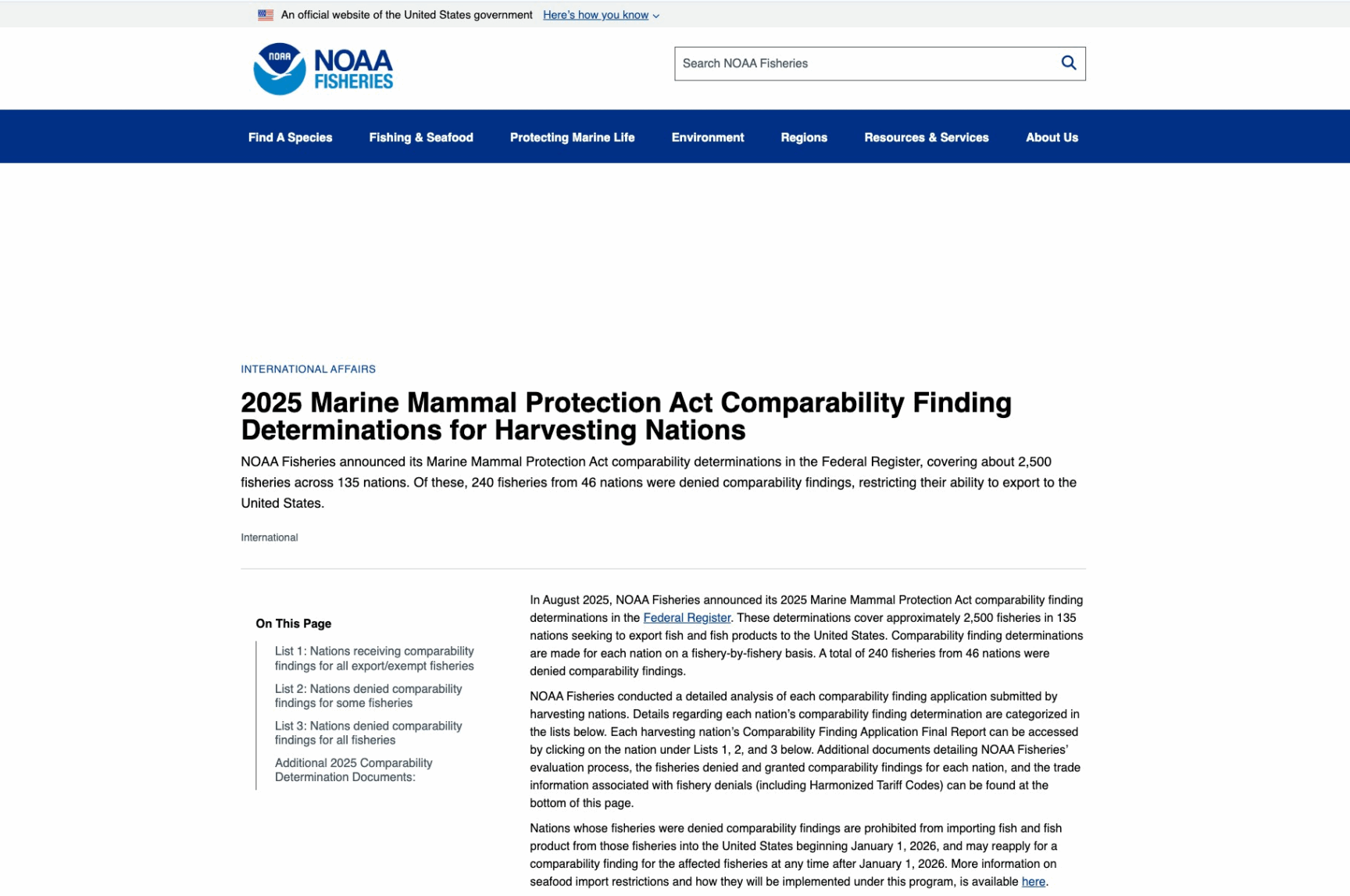
On August 29, 2025, NOAA Fisheries released its Marine Mammal Protection Act (MMPA) comparability findings, following a court order that required the agency to fully implement these provisions. These measures are intended to ensure that foreign fisheries meet U.S. standards for reducing marine mammal bycatch. Beginning January 1, 2026, twelve countries will be prohibited from importing any seafood into the US, and an additional thirty-four countries will have fishery-specific import prohibitions.
What does it cover?
Complete import prohibitions apply to seafood harvested in the following countries:
Benin, Grenada, Guinea, Haiti, Iran, Namibia, New Caledonia, Russia, Saint Lucia, The Gambia, Togo, Venezuela.
Partial (fishery-specific) prohibitions apply to the following countries:
Bangladesh, Brazil, Cameroon, Chile, China, Colombia, Ecuador, El Salvador, Ghana, Indonesia, Ireland, Kenya, Liberia, Madagascar, Malaysia, Mauritania, Mexico, Mozambique, Myanmar, Nigeria, Oman, Peru, Philippines, Saudi Arabia, Senegal, Somalia, South Korea, Sri Lanka, St. Kitts and Nevis, Suriname, Taiwan, Türkiye, UAE, Vietnam.
For those countries with partial import prohibitions, shipments may still be eligible for entry if the importer can provide a valid Certificate of Admissibility (COA) verifying that the product did not originate from a restricted fishery.
How does it apply to brokers?
Customs brokers play a critical role in ensuring compliance and proper documentation for affected seafood entries. For shipments requiring a COA, the document must be validated by the importer of record—and in some cases, by foreign government officials—and submitted electronically through CBP’s Automated Commercial Environment (ACE). Brokers should carefully verify that the Harmonized Tariff Schedule (HTS) code, country of origin, and fishery of harvest are not subject to an import prohibition under the MMPA. They are also responsible for reviewing the COA to ensure it is complete, legible, and matches the shipment data, including product type, volume, and source fishery. Because missing or invalid COAs can result in entry rejections or penalties for noncompliance, brokers should proactively communicate these requirements to their importer clients. Compliance will depend heavily on the product’s HTS classification and the specific fishery or country of origin, so brokers are encouraged to regularly consult NOAA’s MMPA Import Provisions list and CBP guidance for updates.
The Seafood Import Monitoring Program (SIMP)

What is it?
The Seafood Import Monitoring Program (SIMP) is a U.S. program that requires certain seafood imports to meet traceability and recordkeeping requirements to help prevent IUU fishing and seafood fraud. Established in 2016, the program ensures that importers report and retain key data about the harvest, landing, and chain of custody of covered seafood products.
What does it cover?
SIMP currently applies to 13 species and species groups identified as vulnerable to IUU fishing or seafood fraud. Those species are: abalone, Atlantic cod, blue crab (Atlantic), dolphinfish (Mahi Mahi), grouper, King crab (red), Pacific cod, red snapper, sea cucumber, sharks, shrimp, swordfish, and tuna (Albacore, Bigeye, Skipjack, Yellowfin, Bluefin). The program applies only to seafood entering the U.S. from other countries, including products originally harvested in the U.S. but processed or stored abroad before being re-imported.
How does it apply to brokers?
Brokers assist importers by translating the information provided into the proper SIMP “message set” for submission through the International Trade Data System (ITDS) via ACE. This includes accurately reporting harvest and landing data such as species, catch area, gear type, and vessel ID. Brokers also help ensure that appropriate supporting documents are filed and retained, and may flag missing or incomplete data to their clients before entry. While the importer is responsible for holding a valid International Fisheries Trade Permit (IFTP), brokers should be aware that a valid IFTP is required for SIMP entries to be processed. Brokers may also be called in to assist in an audit or investigation of an imported product.
Tuna Tracking and Verification Program (TTVP)

What is it?
The Tuna Tracking and Verification Program (TTVP) ensures that all canned, frozen, and processed tuna products imported into or sold in the U.S. comply with dolphin-safe regulations. The program also monitors domestic tuna processing to verify that products labeled as “dolphin-safe” meet the standards set by the Agreement on the International Dolphin Conservation Program (AIDCP).
What does it cover?
TTVP applies to all frozen, processed, or canned tuna products labeled as dolphin-safe, including species such as Albacore, Bigeye, Skipjack, Yellowfin, and Bluefin tuna. The program traces seafood harvest data, requiring information on species, location of harvest, and fishing methods to verify compliance.
How does it apply to brokers?
For tuna imports labeled as dolphin-safe, brokers assist with preparing and submitting required documents—such as captain’s declarations and Certificates of Origin—through ACE. They ensure that each shipment includes accurate details about the species, harvest location, and gear type to support dolphin-safe labeling claims.
Atlantic Highly Migratory Species (HMS) International Trade Program

What is it?
The Atlantic Highly Migratory Species (HMS) International Trade Program regulates the import, export, and re-export of highly migratory species such as Bluefin tuna, Swordfish, Bigeye tuna, and shark fins. The program ensures U.S. compliance with international agreements and trade monitoring requirements set by regulatory bodies like the International Commission for the Conservation of Atlantic Tunas (ICCAT) and the Inter-American Tropical Tuna Commission (IATTC).
What does it cover?
HMS trade regulations apply to a wide range of species, including tuna, billfish, sharks, and swordfish. All entities importing or exporting the applicable species must submit trade documentation through the CBP ACE, and certain species, such as Atlantic Bluefin tuna, require additional tracing through ICCAT’s Electronic Bluefin Tuna Catch Documentation (eBCD) system.
How does it apply to brokers?
Brokers are responsible for uploading HMS-related trade documentation into ACE, including ICCAT’s Electronic Bluefin Tuna Catch Documentation (eBCD) when required. They ensure that entries contain complete catch and vessel information and may need to coordinate with international partners to gather missing records for compliance with ICCAT and IATTC trade rules.
Antarctic Marine Living Resources (AMR) Program

What is it?
The Antarctic Marine Living Resources (AMR) Program was established as part of the U.S. membership in the Commission for the Conservation of Antarctic Marine Living Resources (CCAMLR). This program uses an ecosystem approach to conserve marine life in Antarctica, focusing on populations like Patagonian and Antarctic toothfish, which are vulnerable to IUU fishing. To combat IUU fishing, the CCAMLR Catch Documentation Scheme (CDS) monitors the international trade of all toothfish and ensures that the trade follows CCAMLR’s conservation measures.
What does it cover?
The AMR Program oversees fresh and frozen toothfish (also called Chilean sea bass, icefish, or Antarctic cod) and Antarctic krill. When importing these species, U.S. importers must submit harvest and chain of custody information. The program includes requirements for pre-approval of frozen toothfish imports, documentation for re-exports, and timely reporting of fresh toothfish imports.
How does it apply to brokers?
Brokers assist with securing pre-approvals for frozen toothfish imports at least 10 days in advance and uploading CCAMLR Catch Documentation Scheme (CDS) forms into ACE. They also ensure timely reporting of fresh toothfish entries and confirm complete chain of custody documentation to meet U.S. and CCAMLR conservation requirements.

Seafood customs brokers sit at the frontlines of trade compliance, navigating an increasingly complex regulatory landscape to ensure that shipments move swiftly and lawfully across borders. While brokers might not bear legal responsibility for import program compliance, they are often the first to face shipment delays, client frustrations, and costly inefficiencies when regulations are poorly designed or implemented. Below are key challenges and accompanying opportunities brokers have identified that can support legally compliant supply chains and regular broker involvement in evolving seafood regulations.
Clarity and practicality of regulations
Brokers have voiced concerns that seafood import regulations—SIMP in particular—can be confusing, duplicative, or poorly aligned with existing customs processes and do not reflect the reality of how data is collected in seafood supply chains. These challenges lead to inefficiencies, delayed entries, and unnecessary back-and-forth with clients. Brokers need seafood import regulations and their accompanying programs to be clearly written, practical to implement, and consistently enforced. Such clarity would reduce the risk of entry errors and enable smoother, more predictable trade.
Modernization of data systems and reporting tools
Customs brokers have traditionally noted struggles with outdated documentation requirements like uploading PDFs, attaching attestations, or collecting non-standard data from clients. These manual processes don’t align with the digital systems brokers use every day. Brokers would benefit from digital, streamlined programs that include machine-readable forms, standardized data fields, and interoperability with CBP’s Automated Commercial Environment (ACE) platform to reduce time-consuming manual work and complexity in entry filing.
Need for pre-clearance and risk-based screening
The “one-size-fits-all” approach to current seafood import screening (especially with SIMP) places an undue burden on brokers and compliant clients, regardless of risk level. Brokers have traditionally pushed for smarter, targeted enforcement to alleviate these challenges. Brokers and their clients need regulatory systems that adopt more innovative screening methods, such as pre-clearance or risk-based screening, that prioritize high-risk shipments and allow compliant products and companies faster, more predictable entry. Brokers can advocate for this shift towards improved screening to reduce the burden of compliance and improve efficiency without compromising enforcement.
Support for traceability and form standardization
Brokers frequently find themselves correcting documentation gaps or chasing clients for missing information on forms, which costs time and money. Improved product traceability, including standardized and harmonized data formats and requirements, would reduce regulatory uncertainty and duplicative data entry efforts and increase brokers’ operational efficiency. By supporting these efforts, brokers can be proactive partners in creating stronger, more trustworthy seafood supply chains.
Inclusion of customs brokers in regulatory design
Policies that don’t reflect operational realities (whether from a broker’s lived experience or current-day supply chain practices) can create bottlenecks at the time of product entry. Governments should include brokers in conversations regarding regulatory development, as brokers have firsthand experience and operational expertise. Their insight can prevent impractical rules, ensure enforcement mechanisms align with customs systems, and ensure that programs reflect on-the-ground realities.
The Seafood Import Monitoring Program (SIMP) is a program designed to prevent illegally caught and fraudulently labeled seafood from entering the U.S. market. Customs brokers play a critical role in ensuring that seafood imports meet SIMP requirements by facilitating the submission of required data and documentation. While importers of record are legally responsible for compliance, brokers are often contracted to submit SIMP entry filings through U.S. Customs and Border Protection’s (CBP) Automated Commercial Environment (ACE), support compliance by validating documents and data before submission, and respond to inquiries if a product is flagged for review. In November 2024, NOAA outlined potential updates to the program in their SIMP Action Plan, which aims to strengthen the program through expanded traceability requirements, improved risk detection, and enhanced compliance support.
Key Considerations for Brokers Supporting SIMP Compliance
While not legally liable for SIMP compliance, brokers often play a key role and are central to the government data submission process. However, the effectiveness of their efforts depends on how clearly and consistently upstream actors provide the required data and how practical the regulatory requirements are in real-world conditions. This section outlines typical areas of broker involvement and the challenges they may face during entry filing.
Supporting Data Submission and Entry Filings
- Harvest and Landing Data: Brokers are often responsible for formatting and transmitting SIMP-required harvest and landing data to U.S. Customs via the International Trade Data System (ITDS). While the importer or their vendors must supply this data, brokers ensure its accuracy and completeness at the point of entry. Late, unclear, or inconsistent data often results in delays or rejections.
- Chain of Custody Documentation: SIMP requires records that show how seafood products moved through the supply chain after landing. Brokers may be asked to assemble or submit these documents, even though they are generated upstream and vary widely in format, quality, and language. Gaps or inconsistencies can result in compliance issues, particularly for complex or multi-origin shipments.
- Small-Scale Fisheries: Required data may be informal, difficult to collect, or unstandardized in supply chains involving small-scale or artisanal fisheries. This puts brokers in a difficult position as they are tasked with filing the entry, but often don’t receive data in a format that meets SIMP expectations.
- Vessel or Farm Information: Brokers may be asked to submit detailed data about the source vessel or aquaculture farm. However, they rely on the importer to provide this information in a complete and usable format. Gaps or inconsistencies are common, particularly with highly processed products.
- Permitting and Recordkeeping Awareness: Although the importer of record must hold a valid International Fisheries Trade Permit (IFTP) and retain records for two years, brokers often support those compliance functions. Brokers benefit from verifying that clients are properly permitted and from understanding recordkeeping obligations in case they are asked to assist during an audit or investigation.
How Could NOAA’s Action Plan to Improve SIMP Impact Brokers?
Expanded Scope of SIMP: NOAA plans to expand SIMP to all U.S. seafood imports, creating a two-tiered, risk-based system. The first tier will include higher-risk species, requiring the full set of SIMP key data elements (KDEs), while the second tier will have reduced reporting requirements for lower-risk species. The species lists for each tier will be periodically reviewed and adjusted based on risk analysis.
Impacts:
- More seafood products will fall under SIMP, increasing the number of entries requiring detailed data reporting.
- Brokers will need to identify and apply SIMP-specific Harmonized Tariff Schedule (HTS) codes for a broader set of species and products.
- Coordination with clients will likely become more complex, particularly for products that previously did not require SIMP compliance.
Pre-Entry Risk Screening: NOAA plans to implement pre-entry risk screening for SIMP imports, requiring importers (or their contracted brokers) to submit data before entry into the U.S. rather than at the time of entry. This will allow NOAA to identify high-risk shipments earlier and work with CBP to prevent IUU and fraudulent products from entering the market.
Impacts:
- Brokers may need to collect and verify data earlier in the entry timeline.
- Processing time for entries could increase, requiring adjustments to scheduling and client coordination.
- Entry rejections or holds could occur before shipment arrival, creating new implications for logistics and client expectations.
Additional Data Collection: NOAA is considering expanding the required KDEs for certain species, including fishing vessel trip dates and more detailed information about transshipment activities, to increase transparency and improve risk detection for IUU fishing and forced labor.
Impacts:
- Brokers may face more complex data entry tasks, particularly for species with transshipment steps or complicated harvest timelines.
- There may be a need for enhanced training or system changes to accommodate new fields or formats.
- Data quality issues upstream could delay entry filings or require more back-and-forth with clients.
Updated Permitting and Reporting Requirements: NOAA plans to clarify the responsibilities of IFTP holders, standardize reporting procedures, and modernize the National Permit System to improve the efficiency of SIMP compliance.
Impacts:
- More consistent workflows may emerge, especially for brokers handling multiple clients with varied recordkeeping habits.
- Brokers may need to verify that clients’ permits are current or assist clients in navigating updated permit systems.
- Potential changes to recordkeeping expectations could increase the role brokers play in compliance documentation.
Voluntary Government-to-Government Data Sharing: NOAA is exploring a pilot program that would allow partner nations to share harvest data in near real-time, enabling more accurate entry data verification and faster risk screening and audits.
Impacts:
- This could improve data accuracy and reduce manual entry burdens, especially if the system integrates with ACE.
- However, timing mismatches between foreign and U.S. systems could still create data delays or entry complications.
Enhanced Compliance Support: NOAA is committed to improving industry outreach, compliance materials, and training for importers, brokers, and foreign exporters. These efforts aim to increase industry understanding of SIMP requirements and reduce reporting errors.
Impacts:
- Increased training opportunities could improve efficiency and reduce compliance errors.
- New guidance tailored to broker needs could help clarify expectations and improve consistency across firms.
Potential Exemptions for Non-Commercial Imports: NOAA is considering a de minimis exemption, which would allow small-value, non-commercial seafood imports (e.g., research specimens, trade show samples, personal-use products) to enter the U.S. without full SIMP reporting requirements.
Impacts:
- Brokers may see fewer entries requiring SIMP reporting in these special cases. However, brokers will still need to determine when exemptions apply, which may require new internal processes or training.
**This action plan serves as a roadmap that NOAA Fisheries will use to strengthen SIMP. It reflects the extensive stakeholder engagement and feedback collected during NOAA’s comprehensive review of SIMP but is not a formal rulemaking and is subject to change.
Insights from FishWise Common Ground Roundtables
From 2019 to 2025, FishWise engaged with seafood stakeholders—including customs brokers—through its Common Ground roundtable series and other industry dialogues to better understand key challenges and opportunities for improving SIMP compliance. The section below maps frequently cited broker concerns to specific elements of NOAA’s SIMP Action Plan, highlighting where proposed updates could address persistent barriers and improve brokers’ interactions with the program.
Volume and Complexity of Data Entry
Seafood brokers continue to cite the significant time and cost burden of entering SIMP data into ACE. SIMP filings often take substantially longer than standard entries—sometimes up to four times as long—straining staff capacity and driving up costs for clients. This complexity has deterred some brokers from handling SIMP shipments altogether. Additionally, there remains limited visibility into how the data supports enforcement, leading to concerns about the return on investment of these efforts.
How the Action Plan could help:
- A risk-based approach leveraging NOAA’s Global Seafood Data System (GSDS) could streamline or exempt lower-risk shipments from full SIMP requirements, reducing the overall volume of complex entries brokers need to process.
- Pre-entry screening may allow brokers to prepare data and documentation in advance, creating more predictability and reducing last-minute data scrambles.
- By focusing scrutiny on high-risk shipments, brokers’ efforts can be more targeted and meaningful, rather than expending significant time on lower-risk entries.
- Centralizing and automating risk review through GSDS could reduce duplicative manual work and improve workflow efficiency.
Clarity and Consistency in Documentation Requirements
Brokers have reported ongoing confusion about SIMP documentation requirements, especially for species with complex supply chains. Recordkeeping expectations often vary based on the product, auditor interpretation, or country of origin, which can result in duplicated effort, inconsistent filings, and delayed entries. The absence of standardized templates further complicates compliance, particularly for multi-species or high-volume imports.
How the Action Plan could help:
- Standardized SIMP reporting procedures could reduce discrepancies between species, suppliers, or auditors, making it easier for brokers to train staff and implement consistent filing practices.
- Clarifying IFTP holder responsibilities would help brokers better delineate who is responsible for collecting and submitting specific pieces of documentation.
- Increased consistency could help brokers set clear expectations with clients, reducing the back-and-forth and duplication of documentation efforts.
Transparency on SIMP’s Impact and Enforcement
Brokers have voiced a need for clearer insights into how SIMP data is used to inform enforcement. Without regular feedback from NOAA, it remains unclear whether data collection efforts lead to tangible outcomes, like the prevention of IUU or fraudulent products. Some brokers also question how and why audits are triggered, especially when certain countries or species seem to be flagged more frequently than others.
How the Action Plan could help:
- GSDS could provide clearer insight into how and why data is used to flag shipments, increasing broker confidence in the compliance process.
- Greater transparency into audit selection and enforcement trends may help brokers and their clients better understand risk factors and proactively mitigate them.
- By receiving updates on program outcomes and risk trends, brokers can make more informed decisions about supporting SIMP shipments and guiding clients.
Technology and System Interoperability Challenges
SIMP compliance continues to be hindered by technology limitations, especially when internal traceability systems are incompatible with ACE. The inability to digitally upload documents or automate data flows leads to manual workarounds and higher error rates, particularly for more complex products like farmed shrimp and canned tuna.
How the Action Plan could help:
- Modernization of the permitting and reporting infrastructure could support better integration between broker software and ACE, reducing the need for manual uploads and copy-paste work.
- System upgrades could allow digital document uploads and better data flow for complex products like canned tuna and shrimp, reducing filing time and error rates.
- Increased compatibility and automation could help brokers scale SIMP filings without significantly increasing staff burden.
Capacity Building and Support for Brokers
Brokers have consistently expressed the need for SIMP-specific training and guidance tailored to their workflows. While many are open to supporting compliance, a lack of targeted resources and limited NOAA engagement to date have left some feeling unprepared or unsupported. Brokers also emphasized that enhanced coordination with foreign governments could ease the documentation burden upstream.
How the Action Plan could help:
- NOAA’s commitment to broker-specific outreach and training would help brokers, especially those new to SIMP requirements, feel more prepared and supported.
- Updated materials, webinars, and potential broker engagement forums could help brokers get answers, share challenges, and ensure consistency across filings.
- Government-to-government collaboration may reduce the upstream documentation burden placed on brokers by shifting data collection responsibilities closer to the source.
As NOAA moves forward with its Action Plan and potential rulemaking, brokers have an opportunity to engage in public comment periods to help shape these improvements to ensure they balance traceability goals with industry realities.
Updated July 21, 2025
1. Why should customs brokers care about U.S. seafood import regulations and trade programs (e.g., SIMP)?
Customs brokers are on the front lines of compliance, ensuring entries for imported products are filed to support efficient trade flow. Effective regulations—not vague nor overly complex—help create a level playing field by keeping illegally caught or mislabeled products out of the U.S. market. Navigable and well-enforced regulations not only reduce confusion and help brokers’ clients stay compliant but can also streamline a broker’s workflow and reduce risk exposure for brokers who are facilitating entries.
2. How does advocating for strong, well-enforced seafood trade regulations benefit my brokerage firm?
Strong, clear rules and well-designed programs level the playing field for supply chain stakeholders and can mean a more predictable import process for brokers. Advocacy helps brokers get there by shaping policies that reduce ambiguity, improve data systems, and streamline reporting requirements. Well-enforced regulations help keep illegal products out of U.S. supply chains, which benefits brokers’ legitimate clients.
3. What changes would make seafood import programs easier to work with?
- Pre-clearance or risk-based screening to help reduce delays in entry filing and facilitate legal trade
- Standardized and harmonized data fields across programs and machine-readable documentation (as opposed to PDFs, attachments, or attestations)
- Interoperability and integration of brokers’ custom data platforms to CBP’s ACE to facilitate data entry
- Clearer importer and exporter resources and guidance to reduce the time needed for brokers to search for required information
4. If customs brokers aren’t legally responsible for compliance, why is it important to include their perspectives when developing or revising regulations?
Customs brokers—especially those involved in the seafood trade—bring operational knowledge and first-hand experience of customs systems and can flag impractical requirements, duplicity, or areas of potential efficiencies. By engaging in the policy process early and consistently, brokers can advocate for realistic, enforceable rules and programs that address legal and ethical trade while not overburdening the entry/customs process.
5. How can brokers get involved in advocating for effective seafood regulations?
- Join trade associations that engage in regulatory advocacy
- Provide practical, grounded feedback to relevant government agencies (e.g., CBP, NOAA, FDA) during public comment periods and periods of program review
- Consider partnering with businesses, coalitions, or individual NGOs calling for supply chain traceability and inclusive and transparent regulatory processes
- Share on-the-ground challenges and opportunities to inform policy improvements
- Encourage peers and clients to advocate for issues that directly affect them and their business operations
6. What benefits do brokers gain by supporting broader efforts to improve traceability, transparency, standardization, and modernization in the seafood industry?
Supporting improved traceability and transparency in the seafood industry helps brokers reduce compliance risks and streamline their operations. Standardized systems mean less uncertainty and more predictability. When there are documentation challenges, shipment holds, or data gaps in information needed to file an entry, a broker is often the one addressing these time-sensitive issues. Proactively speaking up and advocating for traceability, standard data formats, and modern data systems helps make sure programs and regulations work for everyone: importers, brokers, regulators, and the industry at large. Finally, improvements made to traceability and general regulatory compliance mean faster entries for brokers, fewer delays, less time spent on back-and-forth corrections and seeking out data, and a stronger, more trustworthy U.S. seafood market.