
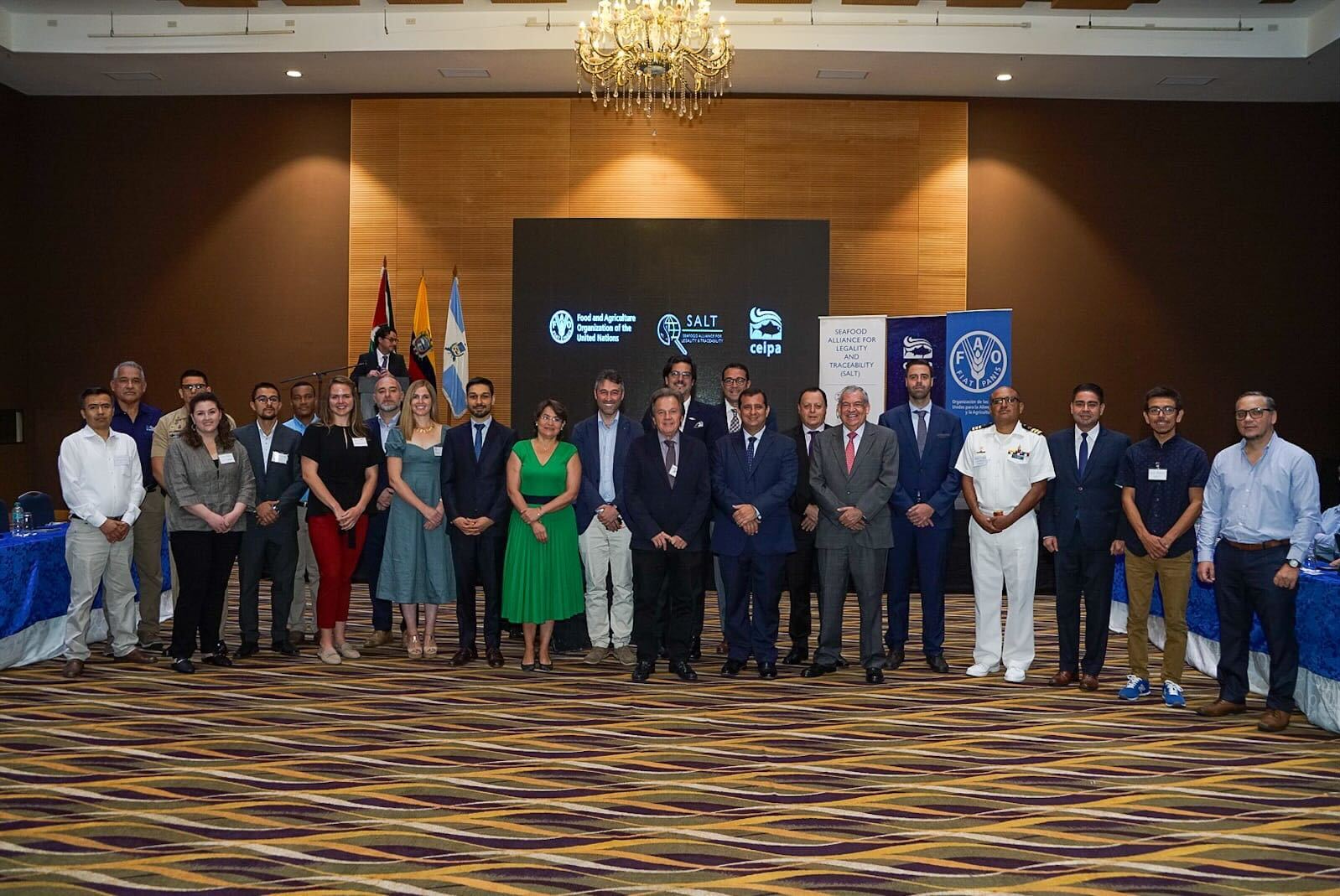
Back in June 2023, SALT co-hosted a workshop with the Food and Agriculture Organization of the United Nations (FAO) Blue Ports Initiative (BPI), and the Ecuadorian Chamber of Industrialists and Tuna Processors (CEIPA). This joint regional workshop brought information and knowledge on the current state of the art of landing sites and traceability systems in Latin American (LATAM) coastal countries. This intervention contributed to increase the efficiency of the seafood value chain by enhancing fish landing sites in LATAM coastal areas, in social, economic and environmental terms.
During the two days of workshop, over 80 participants from nine LATAM countries, including representatives from fishing ports, fishing authorities, seafood industry, and NGOs, shared their experiences and good practices throughout and actively participated in the full agenda to enrich the planned discussions.
DAY 1
BPI and Best Practices for Traceability
The FAO’s Blue Port Initiative (BPI) was the introductory presentation as a guidance for ports as drivers of sustainable development based on a Blue Transformation. Complementarily, SALT presented the Comprehensive Traceability Principles and Pathway Guidance as traceability good practices to support the Roadmap to Becoming a Blue Port. Jointly, both sessions aimed to leverage the formulation of solution-oriented guidance focused on promoting seafood value chain enhancement based on port management and traceability innovations towards sustainability based on a holistic approach addressing environmental, economic and social benefits.
Traceability in LATAM
In the second part of day 1 several countries shared their traceability efforts, from a private-developed electronic logbook for tuna to a public national traceability system. The participants highlighted main considerations to develop a successful traceability system, and acknowledged that programs across LATAM are at various states of incorporating these considerations:
Table 1. Important considerations for successful traceability systems
| Policy/regulation | Technology/infrastructure | Social |
|
|
|
Ecuador’s Main Fishing Port and Monitoring System
The participants visited the Manta Port Terminal, a multipurpose facility for industrial and small-scale vessels. A main feature of this port is an electronic weighing system to control the input-output mass balance. There is also an industrial vessel satellite monitoring center developed and managed by Altura, a private company. With this system, alerts are automatically activated on potential noncompliance by vessels; a first report is generated for these alerts, which is then reviewed by an analyst to generate a complete report and verified at the landing site by inspectors.
Day 2
Market Perspectives
In the day’s opening roundtable, the speakers shared market traceability collaborations between producer and private sectors. In the preamble, the Fisheries Transparency Initiative (FiTI) presented a standard for transparency, as well as some key historical events that have shaped traceability worldwide like global health issues. In Peru, there is a collaboration between a retailer and NGO to directly approach small-scale producers, consisting of a complex training process, direct purchases, and quality product improvement. In Ecuador, a long-standing supermarket chain is seeking traceability for fresh seafood to inform and give tools to the consumer for a responsible choice. Closing the session, the attendees heard about supply chain aggregator company’s experiences engaging artisanal fishers by offering economic incentives. Overall, there was a common motivation to support small and mid-scale fisheries products and provide access to markets.
Tools and Digitalization
In the final panel, initially, it became clear that worldwide fisheries value chains are complex, differing from species to species and from country to country, and having several Critical Tracking Events (CTE) and Key Data Elements (KDE). Technologies also have both positive motivations for their use (incentives) and negative motivations (mandatory) to keep in mind when designing a traceability system; it is most ideal to leverage the former. The speakers presented four technology solutions to track and trace products and digitalize information. Some of the strengths of these tools are digitalization in real time, mobile device-friendly handling, interoperability, regulatory documents integration, AI, and continuous analysis of expenses and inventory.
Ports Challenges and Solutions
The workshop finished with a working group activity where each table discussed challenges to port traceability, identified group or individual solution-oriented projects, and presented their findings to the attendees. The challenges and solutions identified are summarized below.
Table 2. The challenges and solutions identified by workshop attendees
| Challenges | Solutions |
|
|
Overall, the SALT team was thrilled to collaborate with the Blue Ports Initiative, integrating our respective frameworks to support Latin American stakeholders in building more sustainable ports and stronger traceability. We’re excited to continue these collaborations into the future, with the ultimate goal of helping BPI and attendees in catalyzing and operationalizing the multi-faceted traceability solutions identified.