SALT was born from a need to bring together disparate efforts, ideas, and people to advance progress in seafood traceability. SALT began as a five-year project funded by USAID and the Packard, Moore, and Walton Family Foundations, and led by FishWise, a sustainable seafood consultancy.
Illegal, unreported, and unregulated (IUU) fishing represents one of the most complex issues confronting the world today, but addressing IUU fishing, associated labor and human rights abuses, and inadequate fisheries management will improve security, economic prosperity, and food security for the millions of people who depend on fisheries for their livelihoods. Complex systems problems require collaboration and coordination to achieve positive change. SALT leveraged the power of the collective to forge solutions for legal and sustainable seafood, with a particular focus on comprehensive electronic catch documentation and traceability (eCDT)—capturing and using ecological, social, and economic data of seafood products to support and strengthen effective fisheries management, identify and prevent IUU fishing and mislabeled products from entering markets, and support legal and equitable human welfare conditions for laborers.
Together through SALT, hundreds of entities shared ideas and collaborated, and the result was an acceleration in the global sustainable seafood movement toward the inclusive design of electronic seafood traceability. Hear the perspectives of experts around the world who have been a part of SALT along its journey.
Past, Present, and Future of SALT Traceability
In August of 2017, the Seafood Alliance for Legality and Traceability (SALT) was founded to create a global community of governments, the seafood industry, and nonprofits. The United States Agency for International Development (USAID) awarded FishWise a five-year agreement- later extended to six years- to found and lead SALT as a public-private partnership between USAID and the Walton Family, Packard, and Moore Foundations.
The threat of illegal, unreported, and unregulated (IUU) fishing is deemed the top maritime threat due to its impact on food insecurity around the world, as well as violence and human rights abuses at sea and environmentally devastating practices. SALT forged solutions for legal and sustainable seafood, with a particular focus on comprehensive electronic traceability—capturing, tracing, and utilizing ecological, social, and economic data of the seafood products to benefit our environment, seafood workers, and the ocean economy.
Together, hundreds of entities shared ideas and collaborated, and the result was invigoration in the global movement toward the inclusive design of electronic seafood traceability. Hear the perspectives of experts around the world who have been a part of the Seafood Alliance for Legality and Traceability.
Phase One: Co-Design
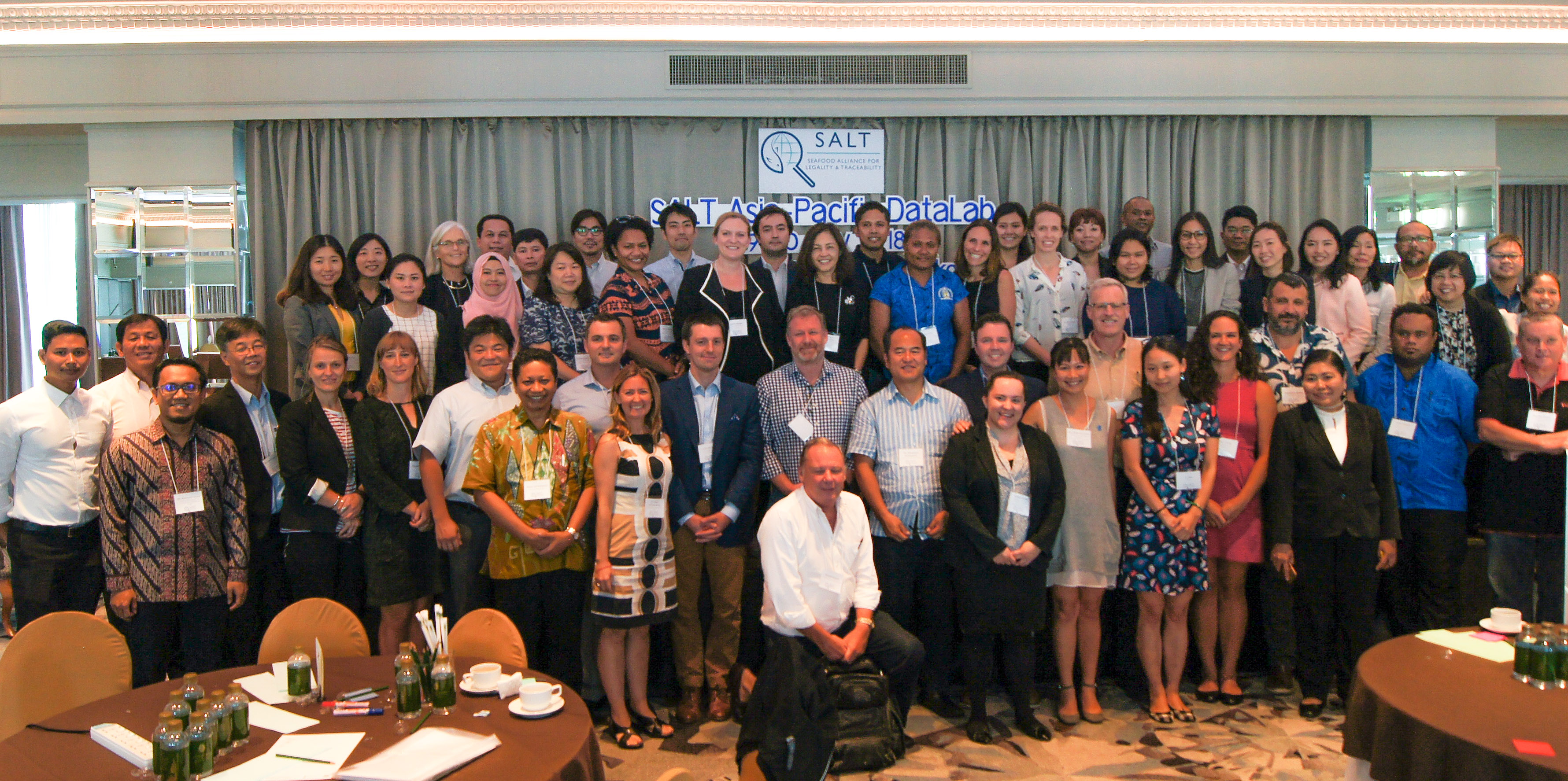
The first step of launching SALT was co-design—a process of consulting with hundreds of stakeholders from around the world to shape SALT’s focus and activities. Co-design fosters ownership from the countries and communities that will access the services and concepts most. To design an effective and impactful project, SALT hosted three regional co-design workshops, called DataLabs. The feedback collected in the DataLabs from seafood stakeholders helped SALT staff understand crucial problem areas related to seafood traceability. Finally, SALT developed a Co-Design Advisory Committee to support the strategic technical approach for SALT.
“Co-Design: a participatory process in which all critical stakeholders, from experts to end users, are encouraged to participate throughout the process of defining issues, designing outcomes, and developing and testing solutions.”
So co-design to me really means that the stakeholders that will be engaged in the work are brought in from the get go, and are defining what the work will look like. So SALT had a layer of co-design upon co-design where the different Global Development Alliance partners that came together first co-designed what they wanted SALT to look like. And then once SALT was awarded to FishWise, FishWise then held a broader collaboration process with all of the stakeholders who would engage in SALT. So that you're not designing something for people, you're designing it with them, and you're also letting them lead. And were they identify what the priorities are, what the best way for them to engage. So it's sort of nothing about us, without us approach to the work.
And I think that's part of what also has made SALT so successful, in that the process of co-design that was done in the first year, in some ways it was what SALT, it was the community, it was the collaborating. So that once SALT then launched from that year of co-design, it was doing a lot of the same things already and relationships had already been formed.
Something I've always felt that SALT has done really well and it's been a valuable contribution, again, it was raising awareness of this idea of taking a comprehensive approach. Because, that I think can be applied even more broadly, of course, than just traceability. So increasing the dialogue around considering all of those different elements. And I think especially, again, uniting the ecological component with the economic component as well. So bringing in the sustainable fisheries management to the work that will contribute to economic growth. And then also, again, the labor component has been really critical. One of the big pushes at USAID that we have is around collaboration, learning, and adapting. And I think SALT has been really adept at bringing that frame to this traceability space. So getting stakeholders to collaborate, trying to learn from best practices and scale those up, and then of course, adapt with the revision say to the principles.
So, I think that focus on knowledge management and learning that FishWise is so good at has been really valuable to bring to traceability as well.
I think one of the things that makes SALT unique is the way it brings together stakeholders across seafood supply chains. So this has been a really important collaboration that has brought together NGOs, governments, and also the private sector, both seafood industry and traceability technology. And I think those players haven't always had a chance to dialogue in the same space prior to SALT. So holding that space for people to come together and tackle these problems has been really valuable.

I joined FishWise in the Seafood Alliance for Legality and Traceability, or SALT in January, 2018 to run the entirety of the program. I had come from a background in working with global alliances and fisheries, but also organizational development in that international process, or international programs. And so when I joined the project, the idea was to really co-design the entire project for the first year of implementation with a variety of partners. Some were partners on the funding landscape, so USAID, Walton Family Foundation, Moore and Packard Foundations as well. And then some were fellow and geo partners, government partners. And we started also in partnership with an organization called Collaborate Up.
And so we went through a process of what we call data labs. And the data labs were meant to be the really information gathering sessions around the globe talking about what people needed when it came to promoting traceability and transparency as a way to combat IUU fishing globally. And so those data labs were hosted. There was an Americas one hosted in the US. There was the EU and Africa one hosted in the UK, and then there was the Asia Pacific one hosted in Thailand.
One of the issues was specifically around the importance of traceability being electronic in nature. So the importance of the ability to transfer secure data more quickly to multiple stakeholders. A lot of systems globally were paper-based, which made it incredibly challenging to manage from a global supply chain level. So one of the issues was around that sort of just fundamental basics of doing electronic systems, but then you encountered issues around interoperability.
So then people go and utilize different technologies. Different governments have different technologies they're using at port. So once that data's electronic, it still has to be able to move through different systems. And so that in particular was something that we saw as a theme, was that you really needed to be able to pull some of those pieces together and be really intentional from the beginning about how to design those. The big thing that we heard was theoretically, traceability is great in concept, but how on Earth would I do it? How would I start to implement such a program? Where would I focus? Who do I need to involve? What's the sort of best learning we could take from other global supply chains that we could apply to seafood?
And so all of those themes kind of keep and kept coming up at the time, which drove our decision in particular to prioritize the question around what are the benefits overall and what is that return on investment for a traceability program? And then how would you go about implementing a traceability program? And for us in particular, we decided to focus the primary audience more on what we called producer country governments, and producer country governments are the source country governments where the product is coming from. Because we saw movement globally with industry talking about traceability. We knew large import markets like the EU or the US were developing regulations, but those producer countries did not have a lot of support in order to utilize traceability or develop the regulations or really just to understand the potential power and value. So we decided to put producer countries as a sort of primary focus to address that gap, but also industry as a strong second in really trying to put the two of those in the same room together to create change.

Phase two: Develop the Principles
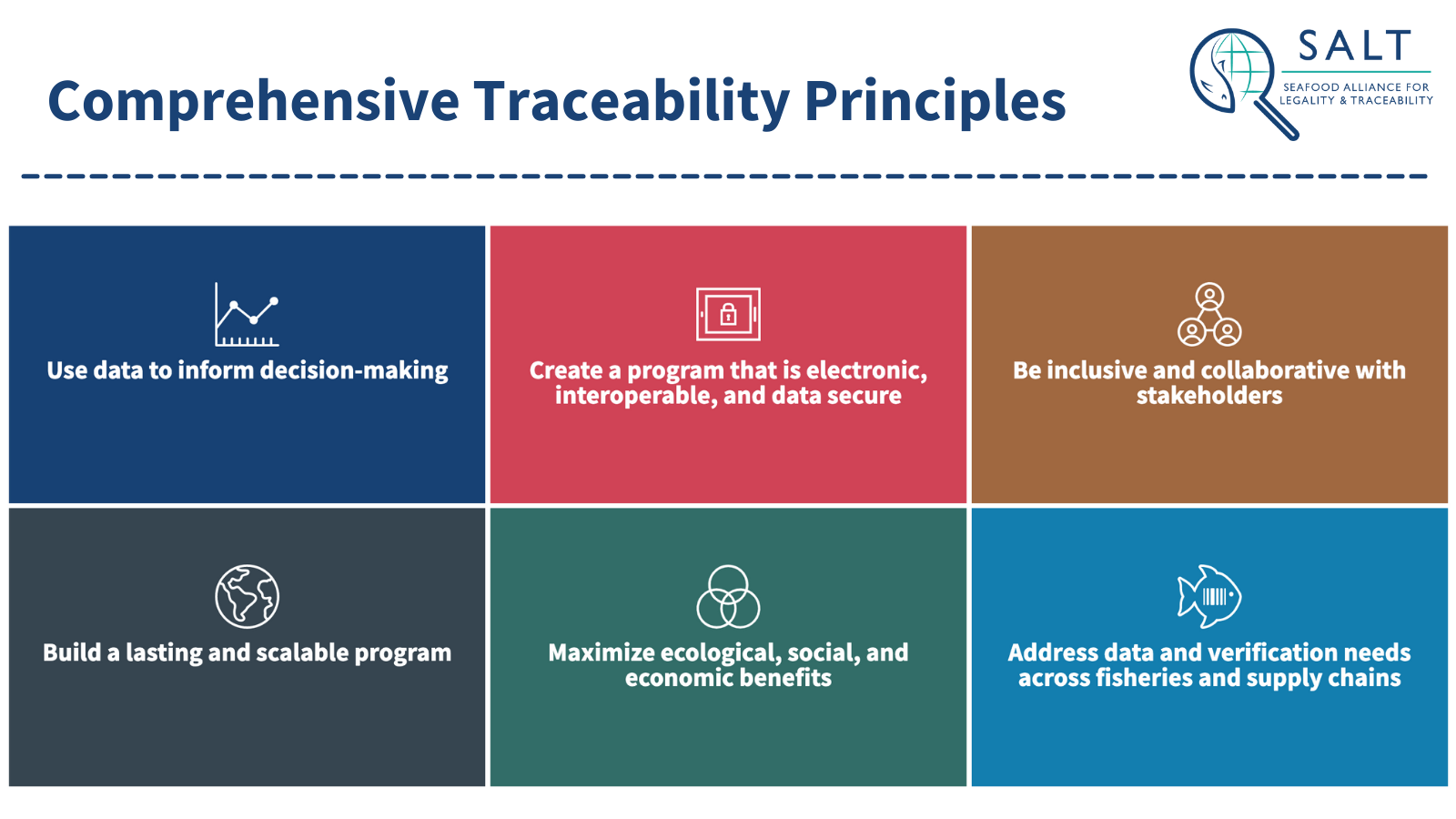
A key milestone for SALT was the completion of the Comprehensive Traceability Principles. Continuing in the highly collaborative methods SALT had committed to, staff worked with 35 experts from 18 countries around the globe, including governments, certification bodies, the seafood industry, technology providers, and NGOs, to collate guidance on how to use traceability data more effectively to achieve economic, social, and ecological goals.
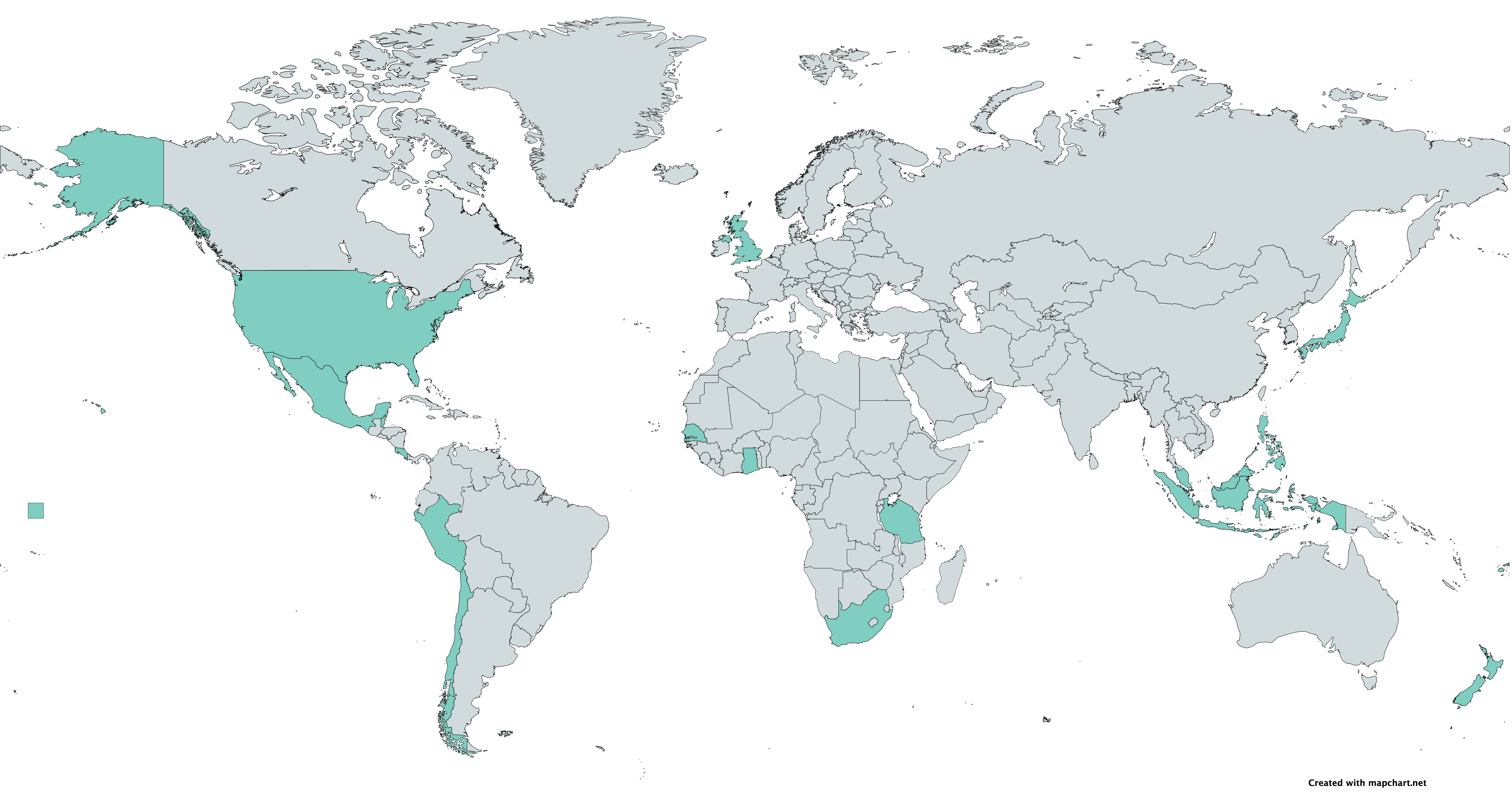
These collaborative efforts helped SALT identify six foundational Principles of a comprehensive traceability system. SALT also developed an accompanying Pathway to the Principles, which makes the guidance actionable by laying out steps to apply the Principles when administering or improving an eCDT program. The work was published in February 2021.
First of all, what I can say that I'm grateful to start for nominating me to be one of the consultative committee members in processing of producing these comprehensive traceability principles. As a consultative committee member, I was able to participate in meetings through video conference. My main role was to provide advice and guidance on comprehensive for principles formation. This was achieved through provision of some information that was appropriate for development of the principle. Also, I was participated in key designing conversation to ensure that the product is relevant and useful and I participated in reviewing and provided some feedback on the content and restructure of the developing principles.
And these six, we come up with six comprehensive cage documentation and traceability principles, which will be used to design and implement electronic seafood traceability in your fishery in marine areas, but also not only the principle, but also we come up with pathways on how the principle will be implemented. That this pathway that is initiating design and implementation will provide guidance and resource for each step toward the traceability program were developed for ecological social and economic goals.
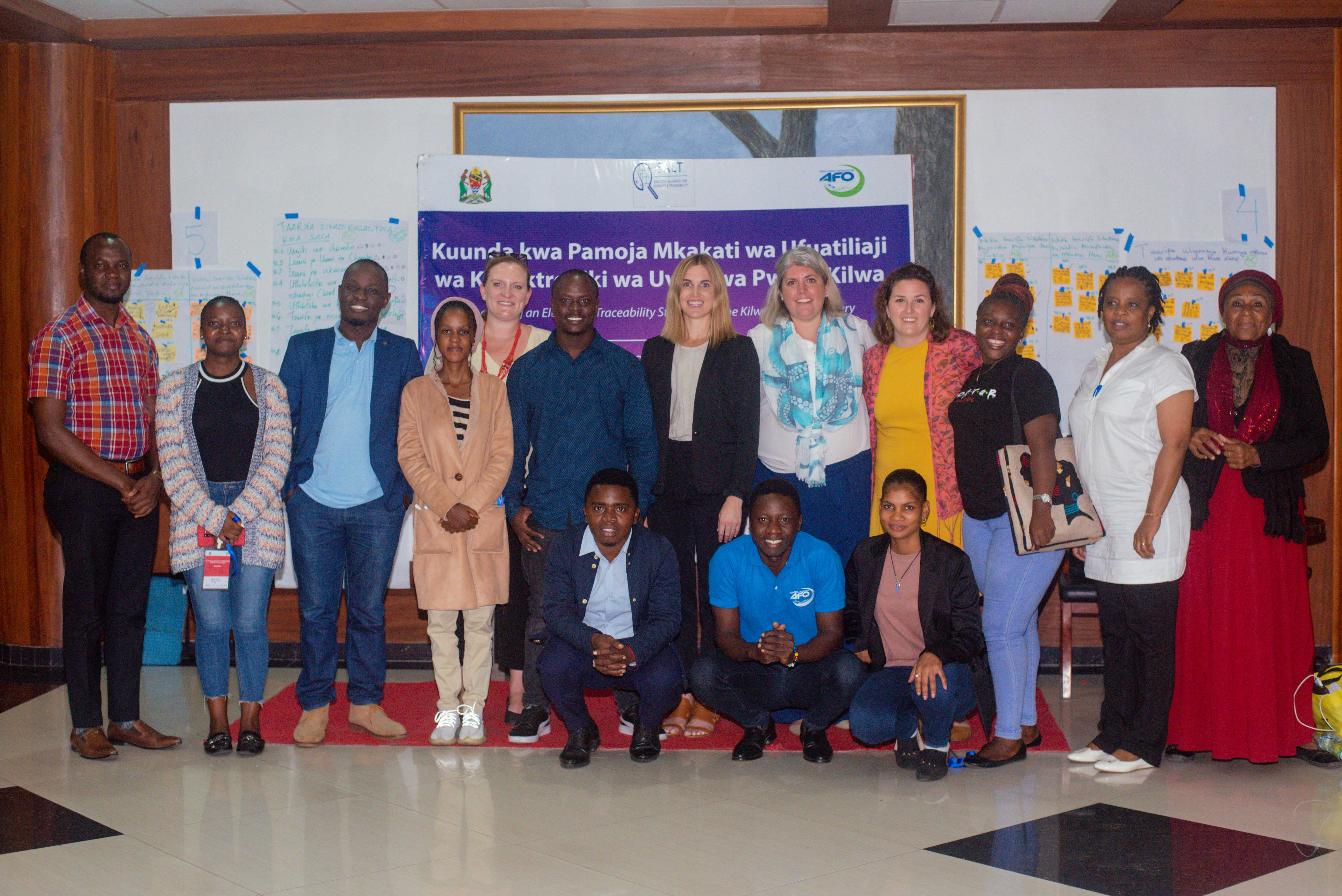
The most important part of principle, which during designing stage was the designing stage of these principles. When we are designing this principle, it was a flexible process so that a technical solution and implementation strategy can vary to reach the identified goals. Another stage was a piloting phase, where you are aware that, after completing this comprehensive principle after being launched, Tanzania was among the beneficiaries to test the application of the principles and the pathways. Whereby I hope upon completion the country can be used to demonstrate to other countries the application and use of these principles. And the project which we have been implemented was aimed to initiate in designing the EDCT program that can aim both ecological, social and economic benefit.
So I think current, we have the octopus strategy in traceability, which upon processing of developing the strategy or the comprehensive principles have been applied and we hope that this strategy can serve as an example to those around the world who are going to need to improve their traceability programs and how the principle and pathway will inform this processing journey.
As you know, currently we implemented traceability. We have a traceability system in place, but it's in paperwork. And with this traceability paperwork has got some challenges. Most of these challenges which we are facing now is in the area of illegal and unreported fishing, [inaudible 00:05:17], including illegal fish trade. And this undermined the management and the collection of traceable information. We lack transparent for the product. Also, we lack data quality between supplier and customers and there's a lack of awareness regarding traceability and there's a loss of information because when you use paper work, you can lose data. The paper might get lost. So I think with this process of electronic traceability documents, all the mentioned challenge which we are facing now, I think, and it's my hope that can be addressed.
There were so many different seafood traceability projects going on across the globe. Tons of lessons were being learned from discreet projects and pilots, but there was no mechanism to gather those conversations, those dialogues, those lessons learned. Aggregate them, compile them into a useful resource, and then share out those lessons learned.
And so, the traceability principles were really intended to do that, to provide high level guidance for folks on what made a seafood traceability project comprehensive, what made it economically, socially, and ecologically considerate.
And when working in traceability, so many stakeholders have to balance different needs, whether it's supply chain management, sustainability concerns, trying to combat IUU fishing, and how do you think of all the needs and implement a tracking system robustly. We were really trying to help folks make that process easier.
Well, we started by going through existing resources and trying to aggregate key lessons. Or again, just key things that folks should consider. And we didn't do that in isolation. We wanted to make sure that we took into account the feedback and input from the community of experts that are on the ground, trying to tackle these issues. So we created the Principles Consultative Committee, which were folks that could help us not only guide the creation of the traceability principles, but also help us guide the application of them and the continuous improvement of them, because we always intended them to be a living resource.
So we worked with this consultative committee through a series of quite a few iterations of compiling their feedback, iterating, et cetera. We also realized that the traceability principles, as I mentioned, were intended to be the high level things that folks should consider when they're implementing traceability systems, and wish them to be comprehensive, in the sense of wishing that they would take into account economic, social, and ecological considerations.
After going through this process with the committee, we realized that we wanted to make something that wasn't just high level principles. We wanted something that was actionable, and that's why we created the pathway to the principles. We wanted to create a resource that would help guide those seafood producing country government representatives to actually take these principles and incorporate them into their system and structure.
It's often difficult to take high level ideas and then apply them to your work, without understanding how others have done so before, or understanding how to go about it. One of the principles is being inclusive and collaborative with stakeholders. Well, that's easy to say and hard to do. So we wanted to draw from folks that have created guides about how to be inclusive and collaborative with stakeholders across seafood supply chains, and also provide examples of folks that have done this well in this space, so people could see what, again, those principles look like in action.
I really wanted to make sure that the resources we were creating were actionable. There are a lot of thought pieces published in this space. And if there isn't a clear route to action or a clear pathway to action, it's a huge missed opportunity to try to get folks to really embody and incorporate the thinking that you're trying to put out into the space. So I really do think that creating actionable guidance is critical. There are so many disconnected resources throughout this space, and there are so many lessons to be learned from each of those pieces. And so, we brought that all together and organized it in such a way that it is more approachable for folks. It feels slightly more, I don't want to say manageable, because it's still a huge undertaking, but by compiling all of these resources, identifying the key lessons to be learned from each of those, and organizing them in an actionable way, we hopefully created an environment in which embodying these comprehensive principles became a little bit easier.

Phase three: Success Stories
SALT was extended to a sixth year in 2021, allowing the project to focus on the implementation of the Principles. Thanks to the many researchers and organizations that came before us, SALT has been able to compile incredibly diverse perspectives and apply comprehensive solutions to traceability hurdles.
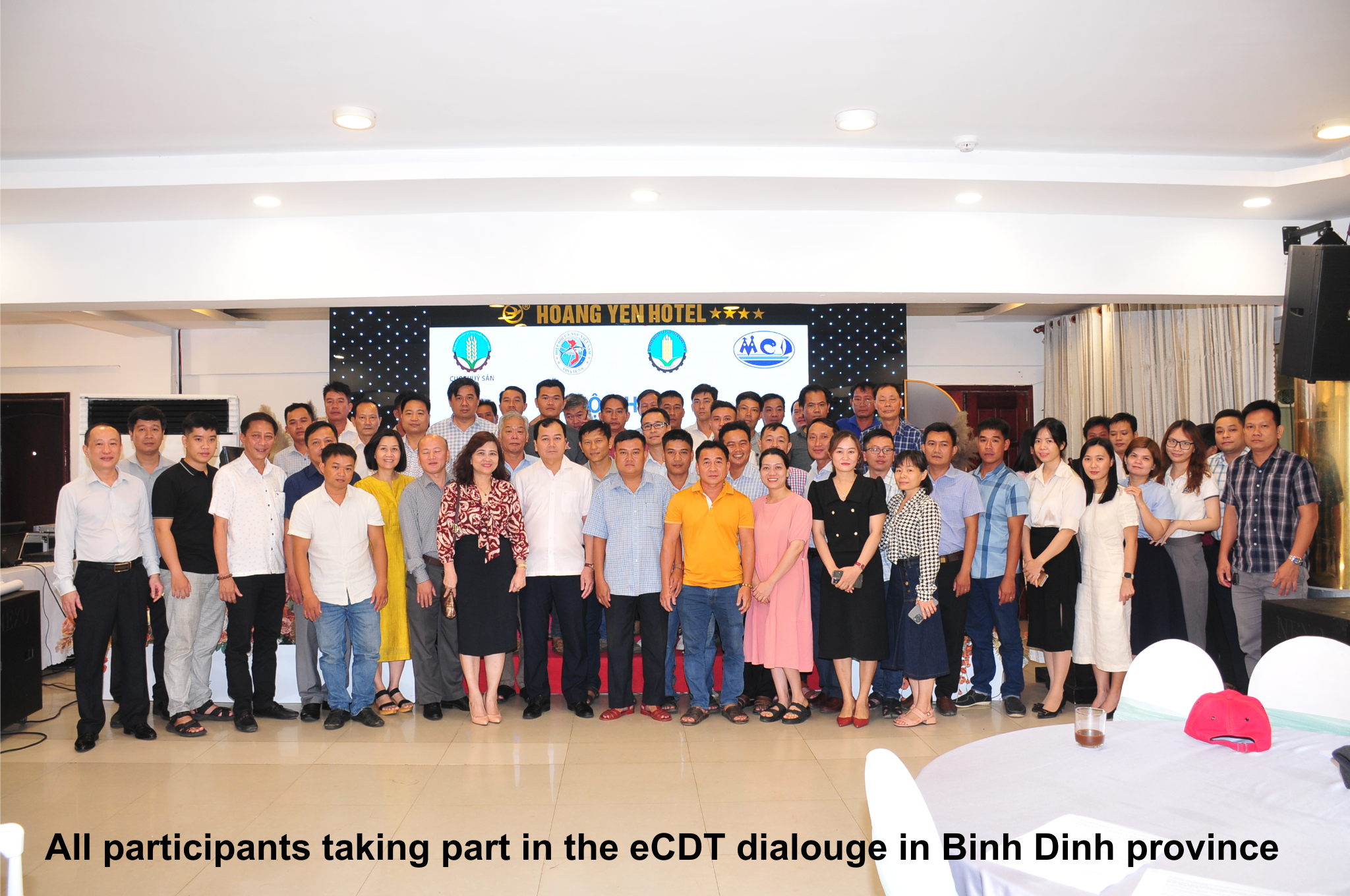
During this phase, SALT partnered with governments and organizations in Tanzania, Vietnam, and across the Latin American and Caribbean region. The goal was always to strengthen the foundation for any seafood traceability program so that solutions are effective and inclusive. SALT worked to publish abundant content and provide technical assistance to aid the gaps in implementing comprehensive traceability programs.
Several organizations have leveraged the Principles and Pathway to move toward more robust electronic traceability programs that intentionally strive for economic, ecological, and social benefits.
Our efforts and SALT's work co-evolved, so we were working at the same time, so we didn't need to change any of the work we were doing, but we did learn with SALT. All the webinars and different consultations that SALT organized were really helpful to organize our ideas and make sure that we weren't forgetting any elements, and so I think it was a co-evolution of SALT's work and then our work with our software provider and the cooperatives to make sure that the product that the software provider was developing was really addressing the needs of the small-scale fisher organizations.
I guess something that SALT has been really helpful was putting together information about experiences in other countries. Because we only work in Mexico we are sometimes in a little bit of our own echo chamber, so part of the value that SALT brought to our work was being able to see what was going on in other parts of the world, places that are really far away from us, both geography-wise and language barriers, so forth, so SALT was really this hub of bringing information from different parts of the world and using that information to offer really practical on-the-ground solutions for developing traceability systems, so that was really helpful, and very much what we also appreciated of SALT's focus was this emphasis on equity and making sure that small-scale producers were part of the conversation and being listened to and included in the conversation.
With SmartFish's support, currently 12 small-scale fisher cooperatives in Mexico are using a digital traceability system that includes a consumer facing portion, so there's a QR code on their products, which tells the final consumer everything about that product, where it came from, how it was fished, who fished it, and so forth.
The cooperatives that we work with vary in size from 40 members to over 200 members, and they are fishing in coastal waters, so these are all day trips. We don't work with any industrial fleets, and they're fishing finfish, different species of finfish, and shrimp, and so in all these cases seafood is the primary source of income for these communities, and so being able to access markets that pay them a little bit more, it makes a huge difference, and there's also, what we have found, is that part of the model includes improving quality and having that label on the final product really makes a big difference.
We had one fisher tell us that, "Oh, so the person who's going to eat this will know that I didn't bleed the fish," and so it really helps improve quality because there's a certain degree of accountability and also a great degree of pride, because now fishers know who's eating their product, and there was even a time where... there were some people who bought the seafood and saw which cooperative it came from and found them on Facebook and put messages on Facebook, like, "Oh, I love the fish. Thank you for the fish," so it was really interesting to see how, through the traceability system, there was able to develop, and Facebook, a direct connection between a final consumer in a large city and a small-scale fisher in a coastal community very far away.
The traceability system is also a key part of improving the internal administration of small-scale fisher organizations, because in addition to providing traceability, it is providing a lot of information indispensable for the correct management of any seafood producing enterprise, so it gives them inventory reports, it gives them first in, first out capability, it enables them to keep very precise records of their fishery, and because the traceability system that we work with is integrated into the national reporting system, we're also helping improve the accuracy of that national reporting system, because what is input into the traceability system, which is the inventory control of the fishery or the fisher organization, is what is used to generate landing reports, so for the first time we have landing reports that are very accurate, because there's an incentive to make them accurate. Traceability is an indispensable element of our Value Rescue Model, for all those reasons.

Phase Four: Carrying the Work Forward
Over its six years of implementation to date, the SALT community has grown to over 2,000 stakeholders from over 80 countries. SALT prioritized several regions for site visits, learning events, and substantial investments in collaboration and knowledge management for traceability. FishWise will now carry on the lasting relationships and momentum from this learning, and FishWise’s team of traceability experts will continue to consult on and implement the Traceability Principles for industry, governments, and nonprofits worldwide.
Hundreds of experts have contributed to SALT. Their efforts have made commendable progress toward adoption of eCDT, and FishWise is eager to carry those accomplishments forward. Hear more about the future of SALT and its mission to expand electronic traceability to benefit seafood laborers, the environment, and our ocean economy.
Our philosophy for how we've approached both the SALT initiative and our work at FishWise are very similar, so it's actually been easy for us to think about continuing it, because both are really based on collaborations with other organizations, knowledge-capture and learning, and sharing that learning, and then thinking about ways to approach traceability and data collection within supply chains in really innovative ways.
So across all three of those areas, we are going to continue that work. We continue to have really powerful collaborations with the private sector, with governments, and with our NGO colleagues and civil society partners for our work in traceability with companies, our work on combating IUU in various geographies around the world and in our social responsibility efforts. So all of that will continue.
Traceability is not an end goal. It's a tool that you use to understand what's going on within supply chains, what's going on within social systems, and then you have to act on it, and so it's always been treated by FishWise as a means to an end. The end that we're actually pushing for is better outcomes for workers, better outcomes for the environment, better outcomes for companies that support livelihoods of fishers and others, and traceability is a way that we are able to keep our finger on the pulse of what's going on within supply chains in support of that end goal. So SALT fits into the work in the same way that traceability fits into the work. It supports a multitude of benefits.
One of the things that we took a lot out of in working on SALT was the USAID's emphasis on monitoring, evaluation and learning. And in the years that led up to SALT, there was a lot of work going on in seafood to just try to get our heads around what the value of traceability in that space really was, and so we spent a lot of our time trying to convince people that they should even think about traceability. And we really didn't have the experience or airtime to get into the question of, how do you know that it's working?
And so the work that we've done under SALT to define some of the things you need to look for within a traceability program to know that it's actually working is some of the more maybe boring-sounding but really truly exciting pieces of the work, because ultimately, the narrative that people really should be investing in traceability based on hypothetical benefits is only going to take us so far. And the future is really going to be built on having tangible sources of information about what really the benefits are, and how we really know, and who and why and all these things, and that can only be acquired through a focus on MEL. So I think that is one part of the work that is now much more ingrained in FishWise's work, but hopefully is much more ingrained into the conversation around traceability globally.

My name is Jason Ko, I am a Biodiversity Senior Technical Advisor at USAID in Tanzania, on the environment and natural resource team. For SALT I was or am the activity manager for USA Tanzania for all of the aspects of the SALT project that were implemented and executed in Tanzania, specifically. The most impactful part of SALT was the, at least, I mean I didn't see it in the day-to-day, but at least the outcome, was the apparent mentoring that the SALT staff did with the local NGO, who had previously very little experience in traceability. They had marine fisheries type experience, but not in traceability, which is a very different concept if you haven't worked in it. And by the end of the project or even halfway through, it was very apparent that they had really built up, the SALT team, had really built up the capacity of the local NGO to be fluent and even be teachers and mentors themselves and advocates for the concepts of traceability and how to apply that.
And I think it was just a really great mentoring capacity building outcome that that local NGO and their staff really benefited from. Looking at the bigger picture of the type of traceability for different types of products, and it does seem to me that seafood traceability is a newer kind of younger sector in that sense compared to say, paper products or wood or even coffee or other products. And so I think consumers and the demand, I don't think change from product to product, that's the same people who are interested in an understanding where their products are sourced from for coffee or paper or wood are also similarly interested for every single product they consume. And so I would hope that seafood does catch up. And I know there are some out there, but they don't seem to be as standardized or as ubiquitous in terms of the penetration of the market, to the day-to-day consumption at restaurants.
And speaking from a country that has a lot of local seafood. And I think the deep sea fishing isn't as exported as much as some other countries, but certainly the seafood industry here is very important that even locally, given the amount of tourism that we have here in Tanzania, I would imagine there's a very large opportunity to capitalize even locally on locally sourced traceability, for understanding which fish they're eating are sustainable and how they came up and how they were connected to different actors in the value chain. So I think there's a great opportunity for this kind of sector To catch up, so to speak and learn from other commodities and hopefully achieve similar levels of use and application by consumers.
And also benefit the producers because I think there's a dual thing here, where you have consumers that are willing to pay more to understand where their products come from and they're sustainable. And hopefully that trickles directly down to the original harvesters and producers of the product who are often the least benefiting as compared to the middle folks and the exporters, processors and such. And I do believe that there's significant benefit to a lot of folks from the fishermen and fisher people on the ground, to the consumers on understanding where their products come from and how they are sourced and how it travels all the way up the chain.